
The product has been added to your cart
 0
0 For support, email customer service

Signs for marking of defibrillators and first aid products are important in an emergency. Emergency exits should be marked with an escape sign.
The recommendation from the European Resuscitation Council is to clearly mark, with a sign using the symbol of defibrillators, the location where a defibrillator is going to be stored. The symbol contains a white heart with a flash in it as well as a white cross in the upper right corner.
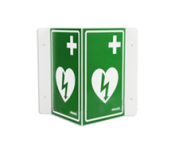


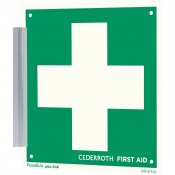


We recommend that the location where a defibrillator is stored be clearly marked with a sign with the defibrillator symbol, which consists of a white heart with a lightning bolt in it and a white cross in the upper right corner.
A cardiac arrest is a stressful situation that is made easier by preparation and practice. Marking where the defibrillator is located is simple but very important. Remember that the defibrillator should be accessible to as many people as possible to be of greatest benefit.
A defibrillator locked away in a storage room is unlikely to save any lives. Therefore, remember to label your defibrillator with signs and instructions. Inform everyone who is near the defibrillator where it is located. Our experience is that it is easy to get a defibrillator and then not inform the staff where it is located. Also remember to place it at a height that even wheelchair users can reach.
A sticker on the window or front door indicating that there is a defibrillator in the premises is recommended, as well as arrows showing the way to the defibrillator. More and more countries have started registers for defibrillators where you can register your defibrillator with the address and the days and times it is available. This register is then accessible to the general public and also to the healthcare system, and can thus quickly find the nearest defibrillator. If you have a defibrillator in your car, it may be a good idea to mark that there is a defibrillator in the car with a sticker.
The best thing to do is to place the defibrillator outdoors to increase accessibility. There are specific outdoor cabinets with heating elements that can withstand temperatures down to minus 45 Celsius. By placing the defibrillator in one, the defibrillator is available all year round, 24 hours a day. These cabinets are equipped with stickers that show that there is a defibrillator in the cabinet. Since most cardiac arrests in the community (approximately 70%) occur in homes, more defibrillators should be placed near homes and associations in communities, preferably outdoors in an easily accessible outdoor cabinet.
One aspect that should be taken into account, however, is the risk of theft. Unfortunately, the risk of the defibrillator being stolen increases with outdoor placement. All defibrillators have a unique serial number and can therefore be identified if someone tries to sell it after a theft, which can reduce the risk of it being stolen. Some insurance companies may insure your equipment even if it is placed outdoors in an unlocked cabinet.
Text written and reviewed by Jonathan Adolfssson, lead instructor for our CPR training and certified trainer in AED and first aid. Read more about Jonathan on our About Us page.


